




CSDE: Correct Side Door Enable
SIL 2 Certified | Compatible with Any TCMS | Balise-Free Positioning
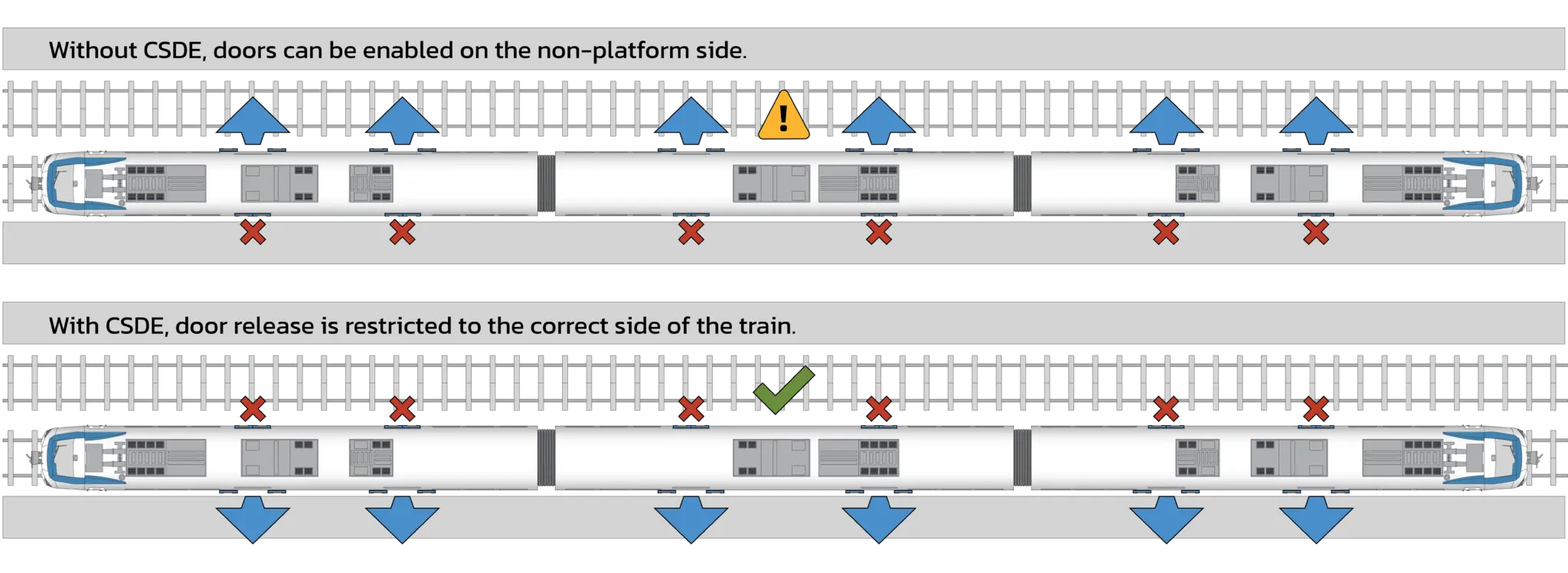
EKE-Electronics’ Correct Side Door Enable (CSDE) ensures that passenger doors can only be enabled on the platform side of the train.
Using train location data and a station database, the system identifies the correct side for door release before the train stops at the platform. CSDE helps prevent wrong-side door release and supports safe train operations across new and existing fleets.
CSDE can operate as a standalone safety application or as an integrated feature within EKE-Electronics’ Automatic Selective Door Operation (ASDO) system
What is Correct Side Door Enable (CSDE)?
Correct Side Door Enable (CSDE) is a railway safety function that ensures passenger doors are enabled only on the side next to the platform.
The system determines train location using odometry, GNSS, and optional beacon data. It then compares the train position with route and station information stored in a database.
When approaching a station, CSDE identifies the correct door side and only allows doors on that side to be released when the train is stationary
Why Use CSDE?
Wrong-side door release can create a serious safety risk for passengers and train crew.
CSDE provides an independent safety layer that helps operators:
- Prevent wrong-side door release
- Improve passenger safety
- Meet railway safety requirements
- Reduce operational risk
- Support both new-build and refurbishment projects
The system remains effective across different train formations and operating scenarios.
CSDE vs ASDO
Although Correct Side Door Enable (CSDE) and Automatic Selective Door Operation (ASDO) are closely related, they solve different operational challenges.
CSDE
CSDE determines which side of the train may be released at a station.
Its purpose is to prevent passenger doors from being enabled on the wrong side of the train. Using train location data and station information, the system identifies the platform side and only permits door release on that side.
ASDO
ASDO determines which specific doors may be released.
It is used when trains call at stations where platform lengths vary. The system enables only the doors adjacent to the platform while keeping remaining doors disabled
CSDE and ASDO are often implemented together.
For example, at a station with a short platform, ASDO determines which doors are alongside the platform, while CSDE ensures those doors can only be released on the correct side of the train.
EKE-Electronics’ ASDO solution includes integrated CSDE functionality.
What Makes EKE-Electronics' CSDE Different?
ASDO provides a flexible and reliable approach to Automatic Selective Door Operation. It reduces engineering effort and strengthens operational safety across varied rolling stock. The system supports new fleets and refurbishment projects without major integration work.
SIL 2 Safety Application
CSDE is designed for railway safety applications and meets SIL 2 requirements.
If a configuration error or communication issue is detected, the system enters a safe state that prevents door activation.
Balise-Free as Standard
The system uses odometry and GNSS as standard.
This removes the need for trackside balises while still providing accurate train positioning. Optional beacon or balise integration is available where additional redundancy is required.
Works with Any TCMS
CSDE can be integrated with any Train Control and Management System (TCMS).
Its flexible architecture supports both modern and legacy rolling stock.
Standalone or Integrated with ASDO
CSDE can be supplied as:
- A standalone Correct Side Door Enable system
- Part of EKE-Electronics’ Automatic Selective Door Operation (ASDO) solution
When integrated with ASDO, the system manages both platform-specific door selection and correct-side door release.
Driver Awareness and Override
The system displays the selected door side to the driver or guard through the HMI.
Where operational requirements allow, the selected side can be confirmed or overridden by authorised train crew.
Core Features
CSDE includes essential safety and operational features designed to ensure reliable performance across diverse rail environments.
SIL 2
Certified
CSDE arrives with SIL 2 certification. reducing engineering work, speeding up deployment, and lowering the total cost across the product lifecycle.
Easy
Integration
Integrates easily with any TCMS, reducing integration effort.
Automatic Direction Change
Door and step status is maintained when the train changes direction or during cab switches.
Station Database with Version Control
The Station Database stores station and platform data for building the network. It’s easy to update for route or track changes and includes version control, viewable via the CSDE HMI.
Automatic Train Configuration
Diagnostic Information
Passenger Information System (PIS) Interface
ASDO can provide next station, platform and door pattern information for the PIS system through the TCMS interface.
Accurate Identification Of Train’s Location
CSDE Configurations
EKE-Electronics’ CSDE system offers a range of optional features to enhance safety, positioning accuracy, and integration flexibility. All options comply with SIL 2 safety standards and are designed for seamless integration with TCMS.
RFID Beacons
Purpose: Provides platform identification and positioning data using RFID technology.
- RFID beacons installed before platforms deliver data on platform ID, length, side, and train direction.
- CSDE validates beacon data against the Station Database and ESN configuration.
- SIL 2 certified data source for enhanced safety.
- Flexible installation: one or two readers per train unit, positioned at cab ends or mid-unit.
- No additional hardware required for later integration.
ETCS Eurobalises
Purpose: Enables CSDE to use ETCS Packet 44 data for platform identification.
- Balises installed before platforms provide platform ID, length, and train direction.
- CSDE prioritises ETCS Packet 44 data over RFID beacon data.
- SIL 2 compliance when using TRDP and SDTv2 protocols.
- No extra hardware needed for future ETCS integration.
TRDP and SDTv2 Protocols
Purpose: Ensures safe communication between CSDE and train systems.
- TRDP and SDTv2 protocols are available on the EKE platform with the required interfaces.
Step Control
Purpose: Configures sliding step patterns for each station.
- Displays step patterns on HMI alongside door patterns.
- Sends enabling signals to TCMS for step control (not a safety function).
Build CSDE using the following modules
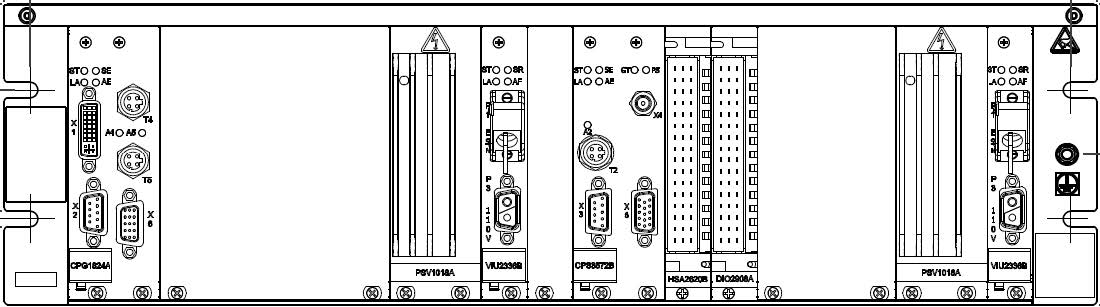
The CSDE system usually consists of two Central Processing Units (CPU), I/O modules, power supplies and a rack. Click on an image to explore related content.
Modular Concept
Below is an example of an CSDE system made up of a selection of common modules. The modules are the minimum required for CSDE, with additional modules available for expanded functionality. For example, HABD is often integrated within the same system. Hover over each area to view a brief description or click to access the full module page.
CPU with Graphical Display Controller (CPG)
Supports DVI and Ethernet display interfaces
Power Supply Unit for VME (PSV)
Provides power for the CSDE HMI
Vehicle Identification Unit (VIU)
Required for door identification for the HMI.
CPU with Serial Links (CPS)
A central processing unit providing serial communication interfaces.
High Speed Analogue Input Module (HSA)
Used for calculating odeometry.
Digital Input Output Module (DIO)
A Digital Input Output Module for delivering digital signals to the CPU modules.
Power Supply Unit for VME (PSV)
A second power supply unit required to power the CSDE system
Vehicle Identification Unit (VIU)
A second VIU required for door identification for the CSDE System

Application Software
The CSDE application software is built on an open-source Linux platform and is coded in C and C++.
Unlike our TCMS platform, which allows users to code their own applications, CSDE application software is built by EKE-Electronics. This protects the SIL 2 certification which requires tools, processes and knowledge about how to produce SIL Safety applications.
Why Choose EKE-Electronics for your ASDO?
EKE-Electronics combines decades of rail expertise, delivering reliable, safety-certified solutions for operators worldwide. Our systems are designed for flexibility, fast deployment, and future upgrades, ensuring long-term value across diverse rail networks.
Trusted Safety-Critical Technology
CSDE is built on EKE-Electronics’ established railway safety platform, developed for reliable operation in demanding rail environments.
Proven expertise in SIL Safety Applications
Flexible Integration for Any Fleet
Frequently Asked Questions
What is Correct Side Door Enable (CSDE)?
Correct Side Door Enable (CSDE) is a safety system that ensures only the doors adjacent to the platform can be released for passenger use. It helps prevent doors from opening on the wrong side of the train.
How does CSDE differ from Automatic Selective Door Operation (ASDO)?
How does CSDE determine which side of the train should open?
CSDE uses train positioning information, including odometry and GNSS data, together with a station database containing platform information. The system identifies the train’s location and determines the correct side for door release.
What Safety Integrity Level (SIL) does EKE-Electronics' CSDE system achieve?
EKE-Electronics’ CSDE is a SIL 2 safety application, with SIL 2 certified hardware and software designed for safety-critical door-side selection.
Is the system compatible with different train types?
Does CSDE require trackside balises?
Can CSDE be integrated with an existing TCMS?
Yes. CSDE is designed to communicate with the train’s TCMS, allowing the exchange of operational and diagnostic information. The system can also be integrated with third-party HMIs where required.
Can the system work with a train's existing driver display?
Yes. CSDE can be supplied with a dedicated EKE-Trainnet® HMI or integrated into a shared train display that meets SIL 2 requirements. Both approaches provide the same operational functionality
What is Packet 44?
Packet 44 or P44 is a data packet used within the ETCS framework to convey information related to the position of trains. The primary purpose of P44 is to ensure that trains receive timely and precise location data, which is essential for maintaining safe distances between trains and thus preventing collisions.
What happens if the system cannot determine the correct platform?
How does CSDE support trains that are coupled or uncoupled during operation?
CSDE automatically determines the train composition through an inauguration process. This allows the system to adapt to changing formations and continue providing correct door-side control after coupling or uncoupling.
What happens if a fault is detected?
The system enters a safe state. In this condition, door enable outputs are prevented from activating, ensuring doors cannot be released until the issue has been resolved.
Can CSDE support Passenger Information Systems (PIS)?
Yes. CSDE can provide door-side information to the train’s Passenger Information System, allowing announcements such as which side passengers should use when alighting at the next station.
Can CSDE support sliding step control?
Yes. As an option, CSDE can determine the appropriate step deployment pattern and provide the information to the TCMS for step operation.
How many cars can be supported in a train formation?
The generic product supports train formations of up to 32 cars, including multiple units and locomotive-hauled configurations.
What infrastructure data is required?
CSDE uses a station database containing information such as stations, platforms, stop locations, and route segments. EKE-Electronics provides a Station Database Tool to simplify data creation and maintenance.